The Ultimate Architectural Guide to Unlacquered Brass Pot Fillers & Stove Faucets (2026)
A wall-mounted unlacquered brass pot filler represents the pinnacle of culinary convenience and European scullery architecture. Mounted directly behind the range, it eliminates the strain of carrying gallons of sloshing water across the kitchen while adding a sculptural, living-metal focal point above commercial cooktops. This comprehensive architectural manual details rough-in height calculations, 1/2" NPT plumbing requirements, high-flow velocity engineering, and an exhaustive head-to-head competitor evaluation across Kingston Brass, deVOL, and Waterstone.
1. Anatomy of an Articulating Stove Faucet: Dual-Pivot Engineering
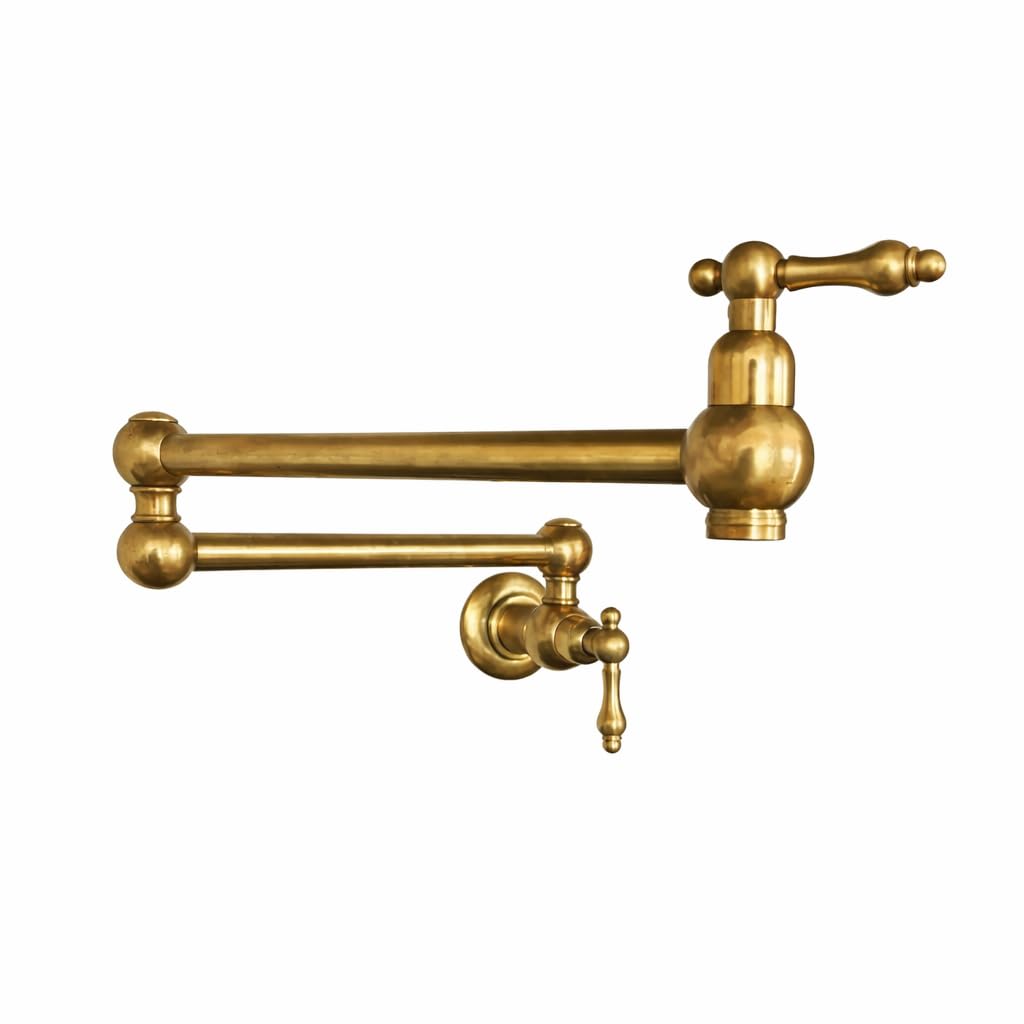
A wall-mounted brass pot filler is an engineering marvel designed to bridge the gap between heavy commercial kitchen utility and refined historic scullery aesthetics.
Unlike fixed sink faucets that remain stationary over an apron-front basin, a pot filler utilizes a two-piece articulating swing arm connected by precision-machined pivot joints. This allows the faucet to extend up to 24 inches outward across multiple cooking zones, fill deep stockpots, Dutch ovens, and pressure cookers directly on the burners, and then fold completely flat against the backsplash tile when cooking commences.
Dual-Pivot Cast Brass Hinges with O-Ring Seals
The primary mechanical stress point on any pot filler is the articulating elbow joint. When fully extended with 4.0 GPM of water coursing through the pipe, hydraulic backpressure and rotational torque place significant strain on the hinge.
Medina Brass pot fillers are cast from dense solid brass with twin EPDM rubber O-rings lubricated with food-grade silicone grease. This ensures velvety, friction-free 360-degree rotation that will never sag, bind, or develop play over decades of daily culinary operation.
Dual Quarter-Turn Ceramic Disc Valves
Standard plumbing fixtures rely on a single control valve. In a pot filler mounted over expensive cooking ranges and gas pilot assemblies, redundant leak security is paramount.
Our architectural pot fillers incorporate two separate quarter-turn commercial ceramic disc cartridges: primary valve at the wall mounting base, and secondary control valve at the articulating spout head. Even if one valve is inadvertently bumped or left open, the second valve guarantees a 100% watertight seal up to 80 PSI water pressure.
The Cold-Water Dedicated Supply Line
Pot fillers must always be plumbed to a single cold-water rough-in line. Never run a hot-water line or hot/cold mixer to a stove faucet. Hot water tanks accumulate dissolved mineral sediment, calcium flakes, and sacrificial anode debris that spoil culinary clarity.
Plumbing cold water directly delivers pristine drinking water for soups, poaching broths, pasta pots, and preserving kettles, while preventing thermal shock to backplate seals.
2. Architectural Placement & Rough-In Height Specs
Determining the exact installation height for a wall-mount pot filler is one of the most critical rough-in decisions during a kitchen remodel or custom build.
Because the water supply pipe must be roughed into the wall stud framing before drywall, tile backer board, and backsplash stone or ceramic subway tiles are installed, precise planning is essential.
The Golden Rough-In Rule: 12 to 14 Inches Above Highest Burner Grate
The universal architectural guideline for wall-mount pot fillers is to locate the center of the 1/2" NPT rough-in pipe 12 to 14 inches above the highest burner grate of your range cooktop.
A standard 12-quart to 16-quart stockpot measures between 9.5 and 11.5 inches in vertical height. Positioning the pot filler spout at 13 inches above the grates provides comfortable clearance to swing the faucet cleanly over the rim without colliding with pot handles or boiling splatter guards.
Centering vs. Offset Lateral Positioning
For standard 30-inch and 36-inch 4-burner or 5-burner ranges, mounting the pot filler dead center behind the range allows the 24-inch articulating swing arm to easily reach all front and back burners with equal ease.
For 48-inch and 60-inch commercial ranges (such as Wolf, Viking, or La Cornue) featuring 6 or 8 burners plus an integrated griddle, consider offsetting the rough-in pipe 8 to 12 inches to the left or right of center. This positions the folded arms gracefully to one side of the decorative range hood tile medallion while maximizing reach across the primary boiling burners.
Structural Timber Backing & Stud Reinforcement
A fully extended solid brass pot filler creates a continuous mechanical lever arm against the wall framing. Drywall or hollow tile anchors are strictly prohibited.
During the rough-in carpentry phase, secure a horizontal 2x6 timber wood block flush between the wall studs directly behind the plumbing elbow. Fasten the brass drop-ear elbow securely to this 2x6 backing using four heavy-duty brass wood screws to eliminate wall deflection.
3. Plumbing Code Requirements & High-Flow Rate Engineering
Kitchen sink faucets are strictly regulated by federal and state energy codes (such as California CEC and EPA WaterSense) to flow at 1.5 to 1.8 GPM to conserve water during dish rinsing.
A pot filler, however, is classified under plumbing codes as an appliance-filling fixture. Restricting flow rate on a pot filler is counterproductive when filling 4 gallons of water for pasta or broth.
High-Velocity 3.5 to 4.0 GPM Flow Rate
Medina Brass pot fillers are engineered with unrestricted high-flow fluid channels and removable full-flow aerators delivering 3.5 to 4.0 gallons per minute (GPM) at 60 PSI.
At 4.0 GPM, a massive 16-quart (4-gallon) stockpot fills to the brim in exactly 60 seconds, compared to over 2.5 minutes using an eco-restricted sink faucet. This saves vital preparation time in high-volume home and commercial chef kitchens.
Standard 1/2" NPT American Female Inlet Threads
All Medina Brass pot filler models feature standard 1/2" NPT female inlet threads that thread directly onto standard 1/2" schedule 40 brass or copper pipe nipples projecting from the finished tile backsplash.
Each unit ships with an architectural solid brass wall escutcheon flange, heavy-duty mounting bracket, hex set screws, and Teflon sealing tape, guaranteeing instant compatibility with North American plumbing rough-ins.
Commercial Drip-Free Ceramic Disc Reliability
Unlike traditional compression faucets that use rubber washers that dry out, bake, and crack behind hot stoves, Medina Brass incorporates diamond-hard alumina ceramic disc cartridges tested to 500,000 continuous cycles.
The mirror-polished ceramic plates slide smoothly against one another to shear off water flow instantly, providing zero-drip security under municipal water pressures up to 80 PSI.
4. Metallurgy & Thermal Endurance: Why Plated Pot Fillers Fail Behind 60,000 BTU Ranges
High-performance gas ranges and dual-fuel ranges produce tremendous thermal energy. Front and rear burners routinely generate between 15,000 and 22,000 BTUs each, producing cumulative cooktop thermal loads exceeding 60,000 to 80,000 BTUs.
Placing a cheaply manufactured plumbing fixture directly in the path of rising convective cooking heat, hot oil aerosolization, and boiling steam vapor is a recipe for rapid cosmetic and mechanical degradation.
The Fatal Flaw of Die-Cast Pot Metal and Clear Lacquer Coatings
Mass-market pot fillers sold at big-box home improvement stores and discount e-commerce outlets are manufactured from die-cast zinc alloy (zamak) or thin fabricated brass sheets coated with a synthetic polyurethane clear lacquer.
When subjected to continuous range burner heat and steam, synthetic lacquers soften, yellow, and micro-crack. Boiling steam vapors penetrate behind the lacquer film, causing ugly milky clouding and blistered peeling. Once the micrometer-thin electroplated wash wears away, the underlying zinc pot metal corrodes into chalky grey zinc oxide.
CuZn37 Virgin Sand-Cast Brass: The Authentic Living Alloy
Medina Brass pot fillers are cast from dense metallurgical virgin brass (65% copper, 35% zinc) in our Marrakech foundry ateliers using centuries-old sand moulding techniques.
Because our brass contains zero synthetic topcoats, clear lacquers, or plastic sleeves, it is fundamentally immune to heat degradation. The raw living alloy withstands temperatures exceeding 800°F with zero structural distortion, absorbing kitchen heat and developing an organic, hand-rubbed antique patina that grows more magnificent every year.
5. The Definitive Competitor Comparison Grid: Medina Brass vs. Kingston Brass vs. deVOL vs. Waterstone
Choosing the ideal brass pot filler requires balancing metallurgical purity, dimensional reach, valve quality, and architectural authenticity. Below is our exhaustive comparison across the four leading brands in luxury residential brassware:
Medina Brass (Marrakech Foundry Collective) - $265 to $345
• Material & Metallurgy: 100% Solid sand-cast virgin brass (CuZn37). Completely solid brass body and articulating arms.
• Finish Type: Raw unlacquered living brass. Organic patina develops naturally with age; can be polished to mirror gold.
• Articulating Reach: 24.0 inches full extension. Folds flush to 3.5 inches from backsplash tile.
• Valves: Dual quarter-turn alumina ceramic disc cartridges tested to 500,000 cycles.
• Flow Rate: 3.5 to 4.0 GPM high-velocity culinary flow rate.
• Plumbing Rough-In: Standard 1/2" NPT female inlet with solid brass escutcheon plate.
• Sourcing & Value: Handcrafted by master Maâlems in Marrakech medina foundries and shipped direct to consumer without middleman distributor markup.
Kingston Brass (Heritage / Continental Pot Filler) - $420 to $680
• Material & Metallurgy: Fabricated brass tubing with die-cast components. Thinner wall gauge (approx. 1.2mm wall thickness).
• Finish Type: Chemically applied antique brass or PVD electroplate. Some models clear-coated with synthetic lacquer prone to heat blistering.
• Articulating Reach: 20.0 to 21.5 inches extension. Shorter reach may struggle on wide 48" or 60" professional cooktops.
• Valves: Standard ceramic cartridges. Functional, but reports of looseness at elbow joints under heavy leverage.
• Flow Rate: 3.2 to 3.8 GPM.
• Plumbing Rough-In: Standard 1/2" NPT.
• Sourcing & Value: Mass-produced industrial manufacturing in Taiwan/China. Moderate quality, but high retail markup through plumbing showrooms.
deVOL Kitchens (Mayan / Ionian Pot Filler) - $1,450 to $1,850+
• Material & Metallurgy: Cast solid brass bodies with handcrafted traditional British detailing.
• Finish Type: Unlacquered brass living finish or aged brass chemical dip.
• Articulating Reach: 21.0 to 22.0 inches extension.
• Valves: Quarter-turn ceramic disc valves with vintage crosshead or lever handles.
• Flow Rate: 3.0 to 3.5 GPM.
• Plumbing Rough-In: UK 1/2" BSP standard, typically adapted with NPT brass fittings for North American orders.
• Sourcing & Value: Bespoke English artisanal cabinetry brand. Exceptional aesthetic refinement, but commanding ultra-luxury pricing with 8 to 14-week overseas lead times.
Waterstone Architectural (Traditional / Modern Pot Fillers) - $1,800 to $2,600+
• Material & Metallurgy: CNC-machined solid brass bar stock manufactured in Southern California, USA.
• Finish Type: Raw brass, living unlacquered finishes, or specialty multi-stage patinas.
• Articulating Reach: 22.0 inches extension with built-in check valves.
• Valves: Proprietary precision-ground ceramic disc cartridges with built-in anti-siphon protection.
• Flow Rate: 3.5 GPM.
• Plumbing Rough-In: Standard 1/2" NPT.
• Sourcing & Value: Premier American CNC luxury engineering. Flawless industrial machining and lifetime support, positioned at the highest apex of luxury price brackets.
The Architectural Conclusion
While deVOL and Waterstone deliver undeniable prestige for $1,500 to $2,500+, Medina Brass provides identical heavy-gauge solid brass metallurgy, superior 24-inch articulating reach, commercial ceramic disc cartridges, and standard 1/2" NPT pipe threads directly from our Moroccan foundry ateliers for $265 to $345.
For homeowners, architects, and interior designers who prize authentic living metal, fair-trade artisan casting, and uncompromised plumbing integrity, Medina Brass delivers unprecedented value.
6. Maintenance & Living Patina Protocol in High-Grease Cooking Zones
Because a pot filler is installed directly over hot cooktops, it is exposed to vaporized cooking oils, simmering steam, and occasional marinara or lemon sauce splatter.
Proper care of an unlacquered living brass fixture is effortless when you follow these foundry-tested protocols:
Routine Daily Cleaning (The Warm Water & Microfiber Wipe)
After cooking greasy meals, wipe the brass arms and valves with a clean microfiber cloth dampened with warm water and a few drops of mild dish soap (such as Dawn or Castile soap).
Never spray commercial degreasers, ammonia-based glass cleaners, or bleach on raw brass. Harsh alkalis strip living patina unevenly and cause streaking.
Managing Acidic Splatters (Lemon, Tomato & Vinegar)
If acidic tomato sauce, lemon juice, or wine splashes onto the brass pot filler, it will dissolve the microscopic copper-oxide patina and create a bright golden spot.
Do not panic. This is the natural behavior of living metal. Simply wipe off the sauce with water. Within 7 to 14 days of normal air exposure and kitchen cooking humidity, the bright spot will oxidize and seamlessly blend back into the surrounding patina.
Microcrystalline Wax Seal vs. Mirror Gold Polish
If you want to preserve the current golden-amber shade and prevent oil stains from adhering to the metal, apply a light coat of Renaissance Micro-Crystalline Wax once every 6 to 12 months. Buff with a clean flannel cloth to create an invisible, heat-resistant barrier.
If you ever desire to restore the sparkling mirror-gold finish of day-one casting, apply a pea-sized dab of Flitz or Cape Cod brass polish with a soft cloth. Buff for 30 seconds and wipe dry—the fixture will immediately shine like liquid sunlight.
Conservator's PrincipleNever introduce abrasive steel wool or caustic ammonia-based bathroom cleaners to raw unlacquered brass. Warm water with natural soap cleans dirt without stripping accumulated antique patina; a 30-second wipe with jeweler’s rouge or brass paste resets to Day 01 mirror gold anytime.
Frequently Addressed Inquiries
What is the standard rough-in height for an unlacquered brass pot filler over a gas range?
The universal architectural standard is 12 to 14 inches above the highest cooktop burner grate. This elevation provides comfortable vertical clearance to slide standard 12-quart and 16-quart commercial stockpots underneath the spout while preventing heat impingement from high-BTU gas burners.
Why do articulating pot fillers require dual shut-off valves?
Safety and ergonomics. Articulating pot fillers feature two independent shut-off valves: one at the wall base flange and one at the spout nozzle. This dual-valve design provides redundant leak protection over your stove and allows you to adjust water flow right at the pot without reaching back across open burner flames.
Should a pot filler faucet be plumbed with hot or cold water?
Pot fillers are plumbed exclusively to a dedicated cold water supply line. Water heaters naturally contain trace mineral scale and dissolved solids that degrade drinking flavor. Cold municipal water from copper or PEX tubing is purer for boiling pasta, brewing stocks, and deglazing pans. Furthermore, heating cold water directly on a high-BTU burner is faster and more energy-efficient.
How does an unlacquered brass pot filler withstand the extreme heat of commercial range burners?
Solid unlacquered brass (CuZn37 metallurgical alloy) is a homogenous dense metal with a melting point exceeding 1,650°F (900°C). Unlike plated pot fillers made from die-cast zinc with clear urethane coats that peel, blister, and discolor under 60,000 BTU burner output, solid raw brass absorbs thermal cycles and cooking vapor naturally, deepening into a rich antique patina.
How does Medina Brass compare in quality and pricing to deVOL and Waterstone?
Medina Brass provides 100% solid sand-cast brass, commercial dual ceramic disc valves, 24-inch double-pivot reach, and standard 1/2" NPT pipe threads directly from our Marrakech foundry for $265 to $345. deVOL ($1,450–$1,850+) and Waterstone ($1,800–$2,600+) offer similar high-end heavy brass metallurgy but carry massive boutique distributor markups and 8 to 16-week lead times. Kingston Brass ($400–$700) uses mass-market factory construction with thinner electroplated metal.
Handcrafted Brass Featured in This Study